INTERREG supports cross-border and transnational cooperation projects aimed at regional development, where live music actors (venues, festivals, networks) can participate as partners by contributing to cultural, social or tourism-related initiatives anchored in local territories. To fit within INTERREG, projects generally need to connect with broader priorities such as: territorial cohesion, economic and social development, environmental transition and/or innovation.
INTERREG suggests two types of projects, based on geographical scope, that can be relevant for live music organisations:
Cross-border (neighbouring regions)
Transnational (large EU regions, e.g. Baltic, Alpine)
The consortium often includes public authorities, regional agencies, NGOs / cultural actors and SMEs.
Funding can range from small-scale cooperation to large multi-partner projects:
Micro-projects: around €25k–€60k, sometimes fully funded;
Standard projects: from €500k to several million euros, generally requiring co-funding (typically 60%–80% covered by the programme)
Calls are launched independently by each INTERREG programme, usually once or twice per year depending on priorities and remaining budget. Some programmes also operate through staged or continuous calls.
INSPIRATION
Micro-project & Cross-border
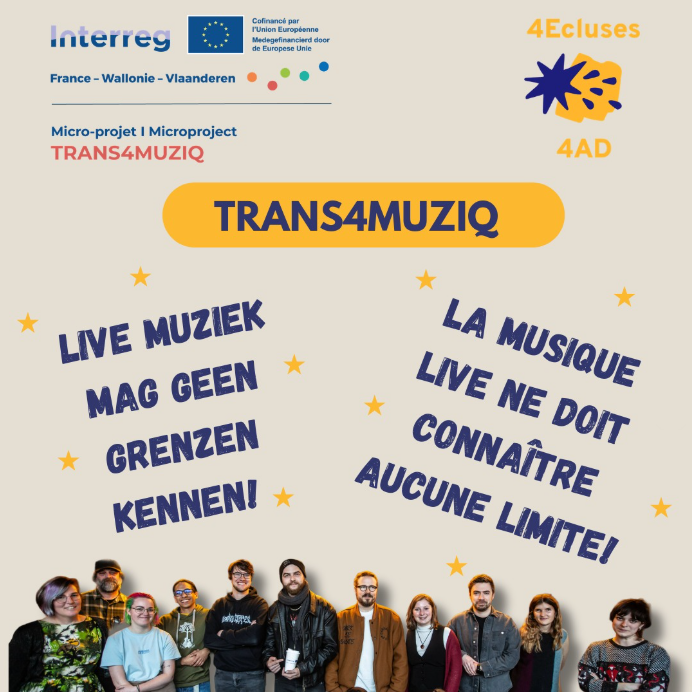
TRANS4MUZIQis a cross-border cooperation project supported by INTERREG VI France-Wallonie-Vlaanderen and led by 4AD in Diksmuide, Belgium, and Les 4Écluses in Dunkirk, France. The initiative aims to strengthen links between live music communities on both sides of the French-Belgian border.
Although borders have become less visible in Europe, artists, audiences and cultural workers still face barriers when moving across territories. TRANS4MUZIQ addresses this through staff exchanges, volunteer meetings, audience mobility activities and concert opportunities for emerging bands.
Cross-border standard project
SAMSPEL63is a cross-border Interreg project supporting music and cultural SMEs in Sweden and Norway through training, networking and collaboration to strengthen their professional development. It aimed to create new opportunities for cultural entrepreneurs to develop sustainable practices, build partnerships and exchange knowledge across Sweden and Norway
Transnational project
MI-RAP is a transnational project in the Baltic sea region supporting music sector actors and public authorities to develop data-driven strategies that strengthen the music ecosystem and its regional development.
European Social Fund +
ESF+ supports projects focused on employment, inclusion, training and skills, where live music actors can have a role if the project addresses social or professional needs, for example training young people, supporting access to jobs, or inclusion through cultural work. The ESF+ is implemented under shared management, meaning the overall framework and objectives are defined at EU level, but each Member State (and often region) designs its own programmes. Priorities are adapted nationally, sometimes regionally, based on local needs. The EU sets broad objectives (employment, inclusion, skills) but the concrete themes, target groups and types of project funded vary by country
Within ESF+, culture must be framed as a tool for employment, inclusion or skills.
You always need to check your national or regional ESF+ programme before considering an application.
INSPIRATION
Music Pool Berlin is a support hub providing advice, training, coaching and networking opportunities to help music professionals develop their careers and navigate the music industry.
Live DMA achieves SHIFT eco-certification
Event organizer :
We are proud to announce that Live DMA is amongst the 17 organisations to have achieved their certification in the third year of the SHIFT programme.
Over the past months, we’ve worked closely with other participating networks, Culture for Climate Scotland and Vector42 to strengthen our commitment to sustainable practices. This collaboration has marked a significant step forward, equipping us with a framework and practical tools to effectively embed environmental responsibility across all areas of our work.
As a direct outcome of this process, Live DMA now has an Environmental Policy, adopted in 2025, that applies to all of our activities and will guide our work moving forward.
Below is the statement issued by Culture For Climate Scotland:
For the third year in a row, participating networks have worked to implement the SHIFT Culture eco-guidelines for cultural networks, with all 17 of the participating networks achieving certification.
Each network has implemented the mandatory guidelines in their organisation along with some optional guidelines from the framework, participated in peer audits with their fellow participants and attended a combined development workshop online. The networks also received an external audit from Vector42 in their first or second year of participation.
The guidelines implemented through the eco-certificate were developed and designed specifically for and by network organisations through the SHIFT project. These organisations tend to be small in size but large in terms of influence, with most of their environmental impact stemming from travel.
Through the eco-certification scheme, networks receive external audits from Vector42 in their first and second year of participation and alternate years thereafter. In the years where no external audit is given networks carry out self-review and a peer audit with their buddy in order to maintain their certification. This approach keeps peer leadership and accountability at the heart of the scheme and builds connections between networks to enable bolder action.
A significant feature of our workshop in autumn 2025 was sharing best practice that participants had developed and implemented through being part of the SHIFT Culture community. Participants also finalised the review of the eco-guidelines ready for their implementation from 2026 onwards.
Since we have now reached the end of the pilot project, 2026 marks a transition year. We at Culture for Climate Scotland have truly valued the opportunity to support the networks in this important journey, from our role in supporting the co-creation of the guidelines through to the three-year pilot project coordinating the eco-certification. From 2027 we will be stepping away from our coordination role in the scheme to allow a different organisation to lead. The callout for a new coordinator is currently live, with a deadline for applications of 6 March.
‘We want to wholeheartedly congratulate the SHIFT Culture community for their achievements in implementing green practice, positioning themselves at the forefront of sustainable change in European cultural work over the past three years, and thank them for the opportunity to be part of it. We look forward to seeing what the next phase brings and wish all in the SHIFT Culture community great success.’ Caro Overy, Green Arts Manager, Culture for Climate Scotland
Congratulations to this year’s SHIFT eco-certified cultural network organisations:
Live DMA & Reset! Network Publish New Maps of Ownership in European Live Music
Event organizer :
Behind many sold-out shows and major festivals, ownership structures remain largely invisible to audiences, yet they play a decisive role in who operates stages, how risks are shared, and where revenue flows.
Live DMA and the Reset! network publish new European ownership maps that make visible who owns which stages across the live music ecosystem, focusing on festivals, venues, and key assets along the value chain.
The European festival ownership map shows that more than 150 of the largest festivals in the European Union — and over 200 when including the UK— are linked to just four groups: Anschutz Entertainment Group (AEG), Live Nation, CTS Eventim, and Superstruct.
Superstruct, recently acquired by private equity firm KKR with CVC as co-investor, owns and operates more than 80 music festivals across ten countries in Europe and Australia. Live Nation operates around 120 subsidiaries in Europe and reported a turnover of approximately $16.7 billion in 2022. AEG Presents combines concert promotion with ownership of major venues such as the O2 Arena in London and the Mercedes-Benz Arena in Berlin. CTS Eventim generated €1.9 billion in sales in more than 20 countries in 2022, operating major ticketing platforms and arenas across Europe.
The new festival map confirms and updates earlier findings, integrating recent changes such as the acquisition of Superstruct by KKR and CVC in 2024. Between 2022 and 2025, the number of mapped festivals linked to Live Nation increased from 74 to 78, Superstruct from 34 to 63, CTS Eventim from 42 to 51, and AEG from 5 to 10.
The venues map shows that large corporations’ ownership and operations are currently concentrated primarily on arenas and stadiums, with groups such as AEG, Live Nation, and CTS Eventim holding stakes in many of Europe’s largest live music infrastructures. At the other end of the spectrum, most small and medium-sized music venues remain independent, associative, municipal, or locally owned.
Making ownership visible
The European Mapping Project on Ownership Concentration in Live Music aims to make visible who owns which stages and to situate this evidence within wider cultural and competition policy debates.
The two ownership maps published today do not claim to be exhaustive, but they make visible a reality that has long been overlooked. They invite institutions, professionals, and citizens to ask a simple question: when we buy a ticket for a festival or a concert, who do we really support, and what kind of ecosystem do we want for live music in Europe?
These two maps have been commissioned by Live DMA & Reset! network.
The research work has been conducted by Matthieu Barreira, independent researcher focusing on economic issues in the contemporary music sector. Recurrent lecturer at Sciences Po Grenoble and Lyon 2 University, he has produced the Cartographie des dix plus importants opérateurs privés dans la chaîne de valeur des musiques actuelles en France (Mapping of the ten most important private operators in the contemporary music value chain in France) for the SMA in 2022 and has since updated it in 2025.
Make Your Audience Your Headliner! Live DMA presents its new audience development tool
Event organizer :
Crowdbuilder is a free, multilingual tool to help live music event organisers develop their audiences and strengthen their communities. It is the result of years of joint work with 17 European venues, driven by a shared desire to put their audiences centre stage. More than just a tool, Crowdbuilder reaffirms the social, cultural and artistic nature of live music venues. It encourages organisers to engage in two-way communication with their crowds to increase their vitality, diversity, and social impact.
Meet crowdbuilder
Crowdbuilder is a new collaborative tool for venues that are looking to actively develop new ways of connecting with their communities. Or, in other words, to make their audience their headliner!
This free and playful tool guides you and your team through the process of designing an audience development strategy. It helps you reflect on your current practices, imagine new perspectives, and develop innovative concepts tailored to your context. Whether you want to reach new audiences, deepen existing relationships, or spark new ideas, Crowdbuilder is here to help.
Crowdbuilder was created by live music professionals, for live music professionals. It builds on collective work led by Live DMA and 17 European music venues, who joined forces to dive deep into the challenges and opportunities of nurturing audiences in small and medium-sized venues.
Driven by a shared desire to reflect on their practices, learn from each other, and contribute to something bigger than themselves, these venues collaborated on a project grounded in care, creativity, and community. Crowdbuilder is the fruit of that collective journey. A tailor-made tool born out of the insights, needs and feedback of live music organisers.
Supporting the cultural and social value of live music venues
Crowdbuilder is a practical tool designed to support the cultural, social and artistic value of live music scene. It places the audience at the heart of the live music experience, reminding us that live music is, first and foremost, about people.
It is part of Live DMA’s long-term commitment to strengthen the cultural, social, and artistic value of live music venues. Since 2017, the network has brought together music professionals from across Europe to reflect on audience dialogue and diversity through a series of workshops and working groups.
These exchanges first led to the launch of the Try-Angle project in 2021 and now continue with Crowdbuilder. This tool is yet another step forward in providing European venues with effective tools to build stronger communities and reaffirm their social role.
How does it work?
Crowdbuilder was designed to be accessible and does not require prior knowledge or specific skills. To make it easier for teams across Europe to use, the tool is available in English, French, Spanish, Dutch and Norwegian, with more translations also on their way.
1. Gather your team
More than just a tool, Crowdbuilder is an invitation to collaborate, explore and share insights. It’s not about having the right answers – it’s about sparking conversations, shifting perspectives, and building a shared vision with your team.
To get the most out of it, we recommend using Crowdbuilder during a team seminar. You can even turn it into a role-playing exercise, where each team member takes on the role of a colleague.
2. Fill in the gaps
You will work with a “fill-in the gaps” text covering six key topics essential for building their audience and community. The tool provides guiding questions and explanations along the way.
You are expected to discuss with your team, write down your insights and come up with a collective answer for each step. Take your time if needed – you can save your progress and come back later.
3. Discover your strategy
At the end of the exercise, you’ll get to discover your personalised strategy. Save it, share it and keep building from there – it’s as simple as that!
Live DMA launches START mentorship programme and calls for mentees
Event organizer :
We are thrilled to launch START, a new mentorship programme aimed at supporting the emergence of live music associations in Europe! This initiative, set to empower new associations, is part of Live DMA’s effort to foster a stronger live music ecosystem in Europe through cooperation and capacity-building.
The call for mentees is now open until 30 November 2025. The call for mentors will launch in November, while the programme is set to take place between March 2026 and September 2027.
What is START?
START Programme, led by Live DMA, aims at supporting the creation and development of live music associations in countries or regions where the sector is underrepresented or lacks structured advocacy or sectorial cooperation. It provides tailored guidance through mentorship and networking to help emerging organisations to become impactful.
It is designed for individuals aiming at creating new live music associations to represent venues, clubs, and/or festivals but need structural support to formalize or increase their influence.
The expected number of participants is between 5 and 10 mentor-mentee pairs.
Why does it matter?
The START programme ensures that all regions in Europe have strong, organized representation for the live music sector. By empowering new associations, we foster a stronger live music ecosystem across the continent.
How does the programme work?
Selected participants will:
— Work in pair with one of the Live DMA members. — Access tools, resources, and contacts to help define their mission, governance, and advocacy goals. — Participate in peer-learning sessions and strategic workshops. — Benefit from visibility and integration into the wider Live DMA network.
What are the benefits?
— Gain a clearer understanding of how to structure a professional association. — Learn from existing national/regional models and avoid common pitfalls. — Build capacity in policy advocacy, funding access, and sector representation. — Lay the groundwork to join the Live DMA network and participate in future EU-funded initiatives.
Live DMA are looking for individuals who are part of emerging associations or informal collectives, ready to take the next step in structuring and growing their association. Through peer learning, exchanges and access to resources, participants are expected to gain the tools and confidence to represent their local scene more effectively.
What does the programme offer?
— Tailored mentorship from Live DMA members — Knowledge-sharing sessions on governance and advocacy — Opportunity to participate and highlight your ideas and experience as well as represent your local music scene in a broader European live music network.
Who can apply?
— Individuals that are committed to build a representative structure — From emerging associations or informal networks working in the live music field — Located in Creative Europe countries with a priority given to regions underrepresented in Live DMA (Central and Eastern Europe, Balkans, Mediterranean countries, Baltics)
How to apply?
Fill in the application form below before 30 November 2025!
Contact the Live DMA coordination team (contact(a)live-dma.eu) if you have any questions or if you need help preparing your application.
We are thrilled to present the results for the HUBS call under Live Style Europe III. The four selected projects show strong cooperation dynamics and concrete ideas that respond to shared challenges faced by independent live music venues, clubs, and festivals.
B2B – Back to Back
Court-Circuit & FEDELIMA will bring together French and Belgian organisers around the RAFFUT! event to compare their working realities, discuss and work on possible solutions regarding shared topics such as working conditions, sustainability, and cross-border cooperation. This project also aims to build long-term connections between networks and local actors.
Borderless Volunteers – Sustainable Volunteer Policy in Music Venues
Clubcircuit and VNPF’s project focuses on the role of volunteers in small and medium-sized venues. Through joint meetings with experts and member venues, the partners will analyse existing practices and co-create a practical toolkit and recommendations for fair and sustainable volunteer policies.
Nordic-Baltic Live Ecosystem
Svensk Live, Dansk Live, LiveFIN, NKA & Music Estonia Live will connect national networks from the Nordic and Baltic region. Using existing showcase festivals as meeting points, they will exchange on grassroots support schemes, financing models, regional touring infrastructures and safety, and identify possible common approaches for the region.
SurveySync
ASACC, Kultura Live & ACCES aim to improve the collection, analysis, and sharing of the data from the Live DMA Survey at the national level. The partners will design a shared online tool and data structure, test it with their member venues and develop recommendations to increase participation, and make better use of the results for advocacy.
These HUBS will run throughout 2026 and 2027, and we look forward to sharing their outcomes with the whole network!
Description of the call
Live Style Europe III (LSE III) is designed to strengthen our network and empower the live music sector through collaborative initiatives, with HUBS playing a key role. HUBS are dedicated peer-learning groups that bring together Live DMA members with shared challenges, allowing them to exchange expertise, develop joint solutions, and implement concrete actions. Through this initiative, members will receive financial support to facilitate staff exchanges, training sessions, and collaborative projects tailored to their specific needs. The goal is to strengthen transnational cooperation, and potentially create scalable solutions that benefit the entire network. By participating in HUBS, you actively contribute to shaping the future of live music in Europe, reinforcing our collective resilience, and ensuring a diverse and thriving sector.
Objectives
Foster collaborations and exchanges of the Live DMA members on shared challenges or priorities, that are specific to some countries or regions or other specific trans-national challenges.
Enhance and improve the synergies between the Live DMA members through smaller networking groups with facilitated access (e.g. no language barrier, geographical proximity, similar business models or public policy schemes)
The Music Puzzle: exploring booking practices in Europe
Event organizer :
This Live DMA research first explores the individual journeys behind the profession, tackling the musical, educational and professional paths of the bookers now on the job, before investigating their daily tasks: how do they operate their booking choices? Where do they get inspiration from? What kind of tools do they mobilize? What are the ups and downs of their current position?
Based on the preliminary insights provided by this research process, Live DMA now aims to initiate fruitful exchanges regarding the futures endeavours of this study. Contact our Research Officer Léna Lozano to set up a workshop or a presentation on the subject! Email her atlena.lozano@live-dma.eu
FEEDBACK BOX
We would now like to build the future endeavours of this research with you! This place is for you to share your feedback, insights, hopes, wishes, needs, ideas, plans… with us, regarding booking practices. What did you think of the study? What would be an interesting follow-up? What would be useful to you?
Green Mobility: initiatives from the live music sector
Event organizer :
In order to better understand a live music event’s carbon emission, and to take action upon it, many organisations have started to measure their carbon footprint. These researches led to interesting results, notably that the most carbon-emitting poles of organising an event are the travels, first of audiences as well as those of artists, especially when they come from far away.
Still, mobility choices and routes are decided by the artists themselves and not left to be decided by the venues/festivals. It is thus the artists who have control over sustainable modes of travel, slower mobility, and other choices that are therefore not part of the artists’ fee or negotiation.
This article presents a bunch of initiatives aiming at reducing carbon emissions regarding mobility: of artists, audiences and cultural workers. Each section presents one initiative in detail, and highlights more succinctly other initiatives.
REDUCE CARBON EMISSIONS FOR ARTISTIC MOBILITY
The mobility of artists, regardless what region of the world they come from and go to, is a key component to cultural exchanges and music discovery. It is time for the live music sector to reflect on current practices that complexify setting-up eco-friendly music events:
clause of exclusivity on some artists’ contract (which prevents them to play in another music event geographically close to the one they have signed the contract for, during a certain period of time)
lack of collaboration between live music organisations to make intelligent and coherent touring routes
cheaper plane tickets compared to other more sustainable means of transportation
difficulties to travel with big instruments on some train lines…
Such practices should be acted upon in order to create a live music ecosystem which is taking better care of the planet.
Focus on… Le Périscope (FR): carbon budgeting for international artists touring
Le Périscope is situated in Lyon (France). They are involved in Footprints: an EU funded project about how to make music more sustainable across Europe. As part of Footprints, the team worked on a carbon budget.
A carbon budget is an excel sheet, and it works the same as a financial budget, but CO2 tons replaces euros. Indeed, the results of the carbon footprint of Le Périscope demonstrated that most of their impact was on artists’ mobility. Indeed, the venue is based in a city centre with public transport and very expensive car parks, so the audience mobility was less important. The objective of Le Periscope is to reduce by 30% their artistic mobility impact until 2030. Each year, they will reduce it by 3%.
The carbon budget is a simple tool. When adding the dates, the number of people travelling with their transport mode and where they come from, the calculation starts. The most difficult indicator was to decide “which part of the touring relies on Le Periscope?” For example: if a band organises a European tour from Australia: the venue could have only counted their impact between the previous (Paris) and next (Geneva) dates, but they decided to calculate the total impact of the tour of each band and divide it by the number of dates they have.
Periscope, Lyon (FR)
In that sense, it is still “possible” to book international bands, but the bookers will have to work more closely with each other to add touring dates in order to reduce the carbon impact of each date, and develop more residencies and local actions. One of the main focus of Le Périscope relies on innovative music and international booking, so the idea is not to transform their programming, but to challenge it. So far, the changes cost more money to Le Périscope because booking train tickets rather than flight tickets is more expensive; but they can use their data to apply to more public funding. But that’s also the condition to stay relevant in the future, not lose credibility and audience.
Le Périscope was also involved in the mutualisation of a tour of American band Dave Rempis Percussion Quartet, which only had one date in Le Petit Faucheux venue in Tours, France. Le Petit Faucheux launched a call to other jazz venues in France in order to find other dates for the band to perform in the country, thus making this international artist’s tour more climate friendly and efficient.
VEGA in Denmark have a no fly-in policy for the artists they welcome on stage. Read more about it here.
ESNS festival in the Netherlands launched their ‘Green Touring Support‘, which encouraged artists who played at their 2022 festival to take the train by covering the financial gap between their normal plans and their sustainable travel plans.
The European Jazz Network presents their Green Pilot Tour project: a tour of an artistic project/band between at least four different venues or festivals and involving at least two EJN members which focuses on innovative touring models based on the principles of sustainable touring and fair and balanced practices in the music sector.
The Green Touring Guide wishes to point out possibilities and tools for reducing the carbon footprint of a tour and how this can be communicated without being suspected of “greenwashing”.
Ecolibrium is a sustainable travel guide for artists.
The information platform Touring Artists offers a section on Green Mobility
The Green Tour Guide offers tips on sustainable touring for Norwegian music sector
REDUCE IMPACT OF AUDIENCE MOBILITY
A live music event is, first and foremost, the encounter between a musical work and an audience. Because these moments of intensity and sharing have, and give, meaning, the idea is not to impeach such encounters. The goal is even to make them more accessible to everyone, regardless of where they live. Still, a change is needed in how we conceive and give access to such events so as they do not have a negative impact on our planet. Because, if there was no music event, the audience wouldn’t be there, the impact of audience travels relies on the concert organiser. It is important for concert organisers to think of sustainability as well as audience safety, accessibility and inclusion when looking into decisions regarding audience travel.
Focus on… Julie’s Bicycle Report “From Carbon Footprints to Cultural Influence: Engaging Audiences on Travel Choices”
Julie Bicycle released a report displaying 5 recommendations for positively influencing audience travel choices. These recommendations, and the report, were also based on a case study developed at UK-based Shambala festival, where the recommendations could be tested through interviews with festival goers, to see if they would be open to the ideas in the report.
The report provides insightful ideas that festivals can implement to incite audiences to change their attitudes and choices when going to a music event. Still, the report does not overlook the barriers and discrimination that implementing sustainable travel choices can entail.
The recommendations of the report are the following:
1. Audiences can be powerful agents of change: Invite audiences to be part of demanding the wider changes needed to break the impasses many events face around travel infrastructure 2. Focus on collective efficacy/agency (what ‘we’ can do; the combined impact ‘we’ can have) and solutions-focused frames so that travel decisions are active/positive choices, not sacrifices or inconveniences: don’t apologise for inviting audiences to be part of positive change 3. Find and amplify human stories that ‘show the change’ rather than focusing on facts and figures. What are the audience values that you can use to frame climate communications for them? 4. Focus on fairness and feasibility: When people perceive a climate policy or a behavioural ‘ask’ to be fair, they are much more likely to support it. 5. Build on the cultural credibility of live events to encourage ‘legacy impacts’: Well-liked live events, with a clear sense of identity and loyal audiences have the cultural credibility to encourage audiences to make wider change in their travel choices, not just around live music.
Study Boomtown which calculated that audience mobility is the biggest factor of emissions at their festival.
To help music organisations calculate their audience mobility carbon-emissions, you can use Crowdimpact.
The venue L’Aéronef in Lille (FR) has developed Aero Easy Go, a webpage inciting their audiences to come to the concerts via sustainable travel options. From reduced train tickets to areas to find people to carpool, co-bike or co-walk together to bike-repair services, they thought of everything! Read an interview about the initiative here.
The venue Ancienne Belgique in Brussels has a strict policy to end concerts at 22:30, so people can still return home after the concert by train. The audience even gets a reduced train ticket when having a concert ticket. More info here.
When it’s not possible to go by bike or public transport to a show because you live in a remote and rural area… the concert comes to you! As seen in the project La Tournée des refuges, which organises artists touring by walking in the mountains, or with the project Sound River System, which organises artistic residencies and concerts on a boat, sailing from city to city.
ESNS Festival collaborates with Choo-Choo for train travel delegates, to help them find sustainable travel options to go to the festival.
Many organisations have focused on promoting carpooling to travel to music events, such as Ecopassenger or Eurostop carpool in Belgium.
And because music events are also places to display other ways of seeing the world and living in it, we are fond of these projects by Dour festival and Les 4 Ecluses venue, which organise bicycle rides to either discover the surrounding area or listen to a concert in-between two pedal strokes.
REDUCE IMPACT OF STAFF & CULTURAL WORKERS
Because some of our readers may be working for organisations involved in the European level, we could not refrain from sharing this sustainable travel decision tool created by On The Move, which helps European organisations design their sustainable travel policy.
Livestreaming: opportunities and challenges for the live music sector
Event organizer :
Live DMA prepared these thematic resource sheets so as to give some keys to live music actors on the opportunities, challenges and current questioning of livestreaming practices.
After COVID and the restrictions on live music events, a rise in livestreamed concerts could be noticed. This phenomenon was also pushed by some public funding bodies, which put “livestreaming” or “digitalisation” as priorities in their calls for project funding.
What is livestreaming, exactly? How are the live music sector and the live video production sector intertwined (or not) together? Are livestreamings profitable? Do they change the relationship between audiences and artists? These are the questions we tried to answer in this resource.
This resource does not give fixed and definitive answers to the question above, but rather gives preliminary investigations, as well as giving staple academic papers on the subject, so that readers can form their own conclusions.
This document aims to give a definition of what can be considered a livestreaming, what are hybrid events and what are the main differences with live concerts.