INTERREG
INTERREG supports cross-border and transnational cooperation projects aimed at regional development, where live music actors (venues, festivals, networks) can participate as partners by contributing to cultural, social or tourism-related initiatives anchored in local territories. To fit within INTERREG, projects generally need to connect with broader priorities such as: territorial cohesion, economic and social development, environmental transition and/or innovation.
INTERREG suggests two types of projects, based on geographical scope, that can be relevant for live music organisations:
- Cross-border (neighbouring regions)
- Transnational (large EU regions, e.g. Baltic, Alpine)
The consortium often includes public authorities, regional agencies, NGOs / cultural actors and SMEs.
Funding can range from small-scale cooperation to large multi-partner projects:
- Micro-projects: around €25k–€60k, sometimes fully funded;
- Standard projects: from €500k to several million euros, generally requiring co-funding (typically 60%–80% covered by the programme)
Calls are launched independently by each INTERREG programme, usually once or twice per year depending on priorities and remaining budget. Some programmes also operate through staged or continuous calls.
INSPIRATION
Micro-project & Cross-border
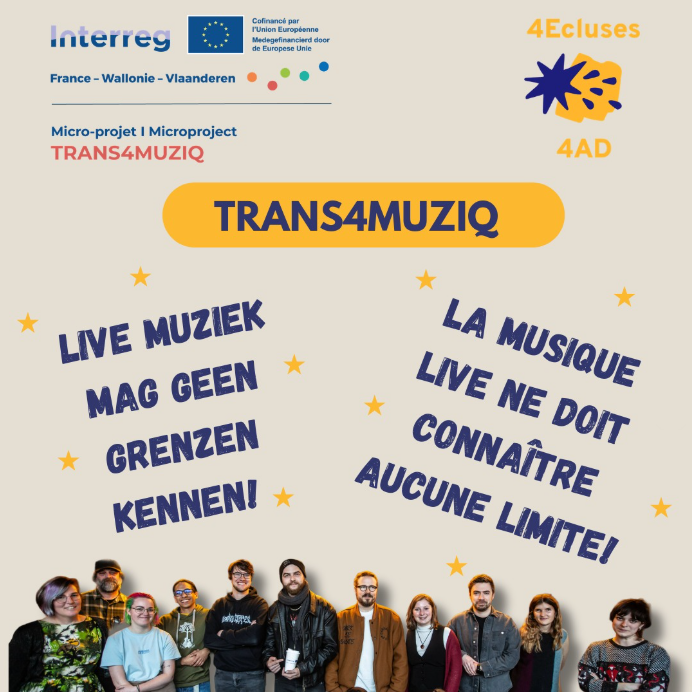
TRANS4MUZIQ is a cross-border cooperation project supported by INTERREG VI France-Wallonie-Vlaanderen and led by 4AD in Diksmuide, Belgium, and Les 4Écluses in Dunkirk, France. The initiative aims to strengthen links between live music communities on both sides of the French-Belgian border.
Although borders have become less visible in Europe, artists, audiences and cultural workers still face barriers when moving across territories. TRANS4MUZIQ addresses this through staff exchanges, volunteer meetings, audience mobility activities and concert opportunities for emerging bands.
Cross-border standard project
SAMSPEL63 is a cross-border Interreg project supporting music and cultural SMEs in Sweden and Norway through training, networking and collaboration to strengthen their professional development. It aimed to create new opportunities for cultural entrepreneurs to develop sustainable practices, build partnerships and exchange knowledge across Sweden and Norway
Transnational project
MI-RAP is a transnational project in the Baltic sea region supporting music sector actors and public authorities to develop data-driven strategies that strengthen the music ecosystem and its regional development.
European Social Fund +
ESF+ supports projects focused on employment, inclusion, training and skills, where live music actors can have a role if the project addresses social or professional needs, for example training young people, supporting access to jobs, or inclusion through cultural work. The ESF+ is implemented under shared management, meaning the overall framework and objectives are defined at EU level, but each Member State (and often region) designs its own programmes. Priorities are adapted nationally, sometimes regionally, based on local needs. The EU sets broad objectives (employment, inclusion, skills) but the concrete themes, target groups and types of project funded vary by country
Within ESF+, culture must be framed as a tool for employment, inclusion or skills.
You always need to check your national or regional ESF+ programme before considering an application.
INSPIRATION
Music Pool Berlin is a support hub providing advice, training, coaching and networking opportunities to help music professionals develop their careers and navigate the music industry.